




.svg)


-3.png?length=1000&name=Inpixon%20LinkedIn%20Banner%20August%202025%20(2)-3.png)

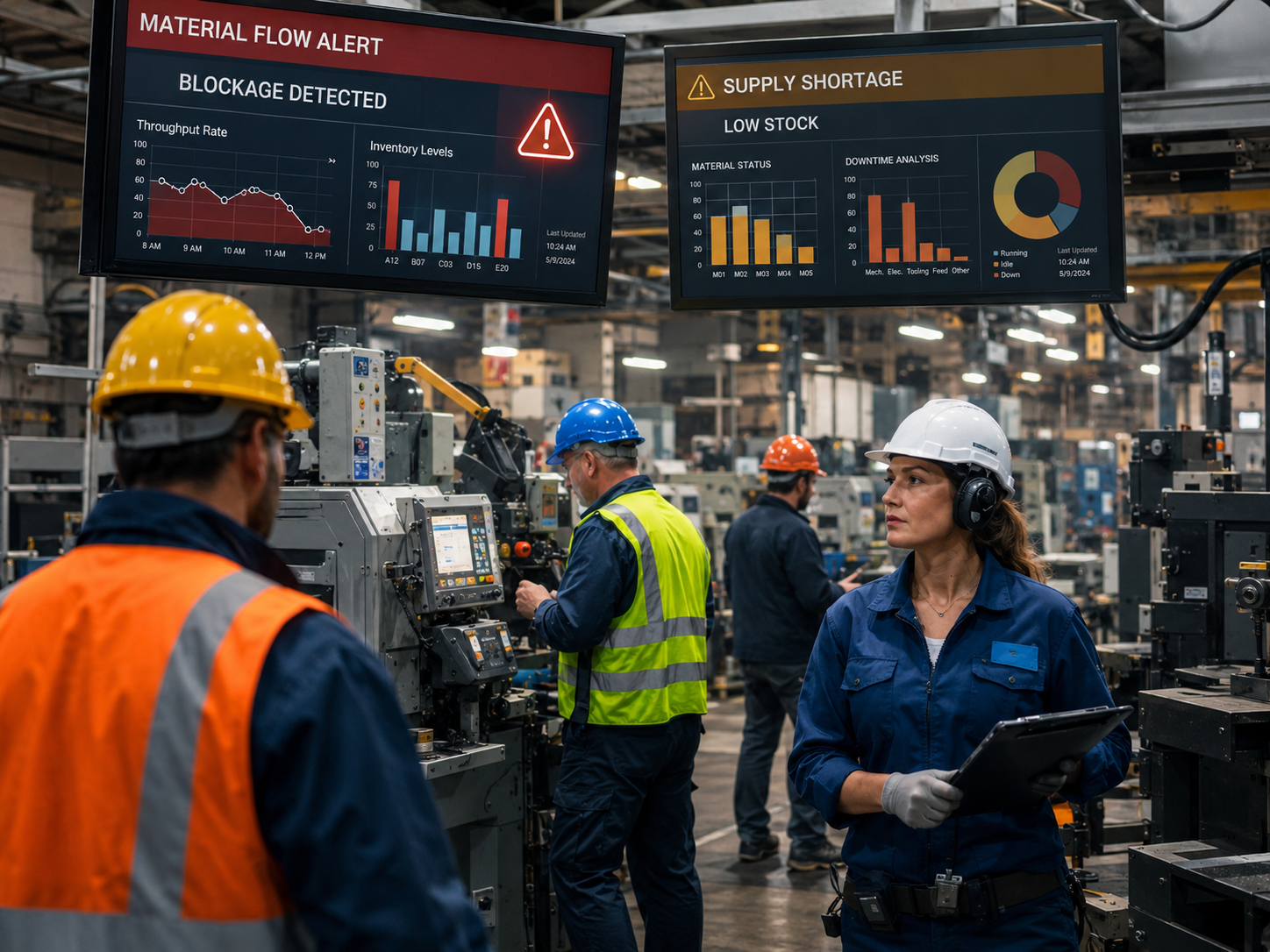

The cost of “close enough” location data in manufacturing is measured in lost overall equipment effectiveness (OEE), avoidable labor cost, and constant firefighting on the shop floor. When your work-in-progress (WIP), tools, and automated guided vehicles (AGVs) are tracked with delay or only to “zone level,” every blind spot in location data turns into a bottleneck you only see once it’s already hurting throughput.
When “Near Real Time” is Not Enough
Many plants already capture location or status, but with gaps: manual barcode scans, passive RFID gates, or updates that hit the MES several minutes late. In a high-complexity manufacturing environment with high labor costs, that delay quietly erodes OEE every shift.
In high-mix low volume (HMLV) and other manufacturing operations, three realities collide:
- Paths change daily: In HMLV, a “batch of one” may take a unique route through cells, rework, and special testing. Manual tracking cannot keep up at scale.
- Tight takt times: Automotive lines live and die by Just‑in‑Time and Just‑in‑Sequence flow. A missing carrier or tool can stop the line in minutes.
- High hourly rates: Every minute that a skilled technician spends searching or waiting is expensive waste, not just “overhead.”
The question is no longer “Do we have data?” but “Is our data precise and fast enough to automate process triggers without manual intervention?”
The Domino Effect of Real-Time Blind Spots
Delayed or low-precision location data doesn’t just cause small inefficiencies; it creates a chain reaction across your entire flow.
1. The Hidden Cost of the Search Party
If technicians spend 10–15% of their shift searching for WIP carriers, calibrated tools, or fixtures, that is pure non‑value‑added time. In a high-labor-cost plant, this is one of the most expensive forms of waste.
Typical patterns:
- Searching for WIP: Operators walk the floor, check racks, or call colleagues to find the right batch or chassis because status in the ERP does not match physical reality.
- Tool hide-and-seek: Specialized torque tools, jigs, or inspection gauges migrate between cells, and no one is sure where they last were used.
- AGV uncertainty: Without reliable position, dispatchers add manual checks, radio calls, or paper notes to confirm where material actually is.
With precise RTLS asset tracking, staff can see the live location and last known path of each WIP carrier, tool, or AGV on a map, cutting search time and improving asset utilization. Inpixon’s technology‑agnostic RTLS platform is built to provide this unified, real-time view across thousands of tracked assets in industrial facilities.
2. The Bottleneck Shadow
When your visibility is delayed, bottlenecks only become visible when a line has already slowed or stopped.
Examples you may recognize:
- A welding cell quietly accumulates a queue of frames, but no one notices until downstream stations run short.
- A drying oven or curing station runs at full capacity, yet the real dwell times and queues are hidden in spreadsheets and manual logs.
- Rework or quality-hold zones fill up unobserved, causing sudden surprises in final assembly.
A real-time locating system can geofence critical areas and automatically calculate dwell time, queue length, and throughput for each step without manual time studies. Inpixon’s RTLS platform, for example, uses precise geozones and automated time stamping to reveal where material flow is slowing and where true bottlenecks form, allowing earlier intervention before a line stop.
Explore how Inpixon supports production tracking and bottleneck detection
3. The Inventory Buffer Trap
When planners and supervisors do not fully trust current‑state visibility, they compensate with safety stock. This is especially common in HMLV environments with frequent changeovers and variant-driven uncertainty.
Typical symptoms:
- Extra raw material stored near lines “just in case,” eating valuable floor space.
- Duplicate kitting or staging of the same material in multiple zones because digital inventory does not match physical position.
- Longer lead times and cycle times than necessary, because planners build in buffer for location uncertainty.
When RTLS feeds accurate, real-time location and movement data into ERP, MES, and WMS, safety stock can be right-sized based on what is actually happening, not what should be happening on paper. Inpixon’s RTLS platform integrates with existing IIoT and enterprise systems to create a connected digital twin of material and asset flow, reducing unnecessary buffers while maintaining service levels.
See how Inpixon supports industrial manufacturing with connected visibility
4. The Compliance Lag
In regulated industries like aerospace and medical devices, demonstrating process adherence is non‑negotiable. Yet many plants still rely on manual scans and paper logs to prove:
- A component stayed in a drying oven for the required 20 minutes.
- A part followed the approved route through inspection, cleaning, and assembly.
- Temperature‑sensitive materials stayed within specific zones or time windows.
When timestamps depend on human action, gaps and errors creep in. RTLS closes this compliance lag by automatically logging when tagged items enter and exit geofenced process zones, calculating dwell time, and storing this data for audits. Inpixon’s RTLS solutions support automated traceability and digital records that can be aligned with your MES and quality systems for faster, more robust audits.
Why Precision and Speed Matter in HMLV and Complex Manufacturing
In both HMLV and complex manufacturing environments like automotive, the stakes are high, but the dynamics differ.
| Environment | Core challenge | Why sub‑meter, real‑time RTLS matters |
|---|---|---|
| Automotive | Maintain just‑in‑sequence flow, prevent line stops | Exact chassis, carrier, or rack must be in the right station at the right second; precise RTLS helps keep takt time stable and flags mis-sequencing early. |
| HMLV / “Batch of One” | Complex, variable routes and unique process paths | Every job may be unique; automated location tracking replaces unscalable manual scans and supports flexible routing and dynamic scheduling. |
Inpixon’s RTLS platform is designed to deliver sub‑meter accuracy where needed, across different RF technologies, and to compute key production metrics such as dwell time and cycle time from actual movement, not assumptions. This enables more precise control of takt time, earlier detection of deviations, and higher confidence in your OEE calculations.
From Data Points to a Digital Twin of Your Shop Floor
RTLS is not just about dots on a map. For an Operations Director, the value comes when those dots become a live digital twin of process flow.
With a modern RTLS and analytics stack:
- Geofencing turns physical zones into digital triggers. As WIP, tools, or AGVs cross boundaries, the system updates your ERP or MES automatically — no barcode scans needed.
- Automatic timestamps transform movement into reliable lead time and cycle time data, making bottlenecks visible as they form.
- Integrated analytics add context, revealing which products, orders, or shifts are driving delays, not just where material is sitting.
Inpixon’s manufacturing solutions combine real-time location data with IIoT and enterprise systems to deliver production tracking, paperless manufacturing, and analytics on a single, scalable platform. This helps plants shift from reactive problem-solving to proactive steering of throughput and floor-level transparency.
Adding askPixi: Agentic AI on Top of RTLS
Once live location data is in place, the next step is using it intelligently. This is where askPixi, Inpixon’s location‑aware, agentic AI for manufacturing and logistics, comes in.
By connecting RTLS data with ERP, MES, and WMS, askPixi can:
- Answer conversational questions like “Where is order 4711 right now?” or “Which work centers are currently causing WIP queues?” based on live movement data.
- Predict disruptions, such as a likely material shortage or sequence break, and recommend or initiate corrective actions inside defined rules.
- Reprioritize tasks and adapt capacity planning in real time, keeping machines busy while minimizing manual rescheduling.
This blends the strengths of RTLS with AI-driven decision support, turning your digital twin into a scalable co-pilot for operations teams. Instead of scrolling through dashboards or spreadsheets, supervisors can simply askPixi what matters now, and act faster.
Learn how askPixi supports on-time delivery and operational foresight in this latest webinar.
Evaluating Your Visibility Gap
For many plants, the core question is not whether RTLS is interesting, but whether your current visibility is good enough to hit your OEE, lead time, and throughput targets without overstaffing or overstocking. As you think about “close enough” versus precise, real‑time data, consider:
- Can you see your WIP flow in real time without refreshing a spreadsheet or walking the floor?
- How many minutes per shift do your highly‑paid technicians spend searching for carriers, tools, or AGVs?
- Is your MES or ERP data based on what should be happening, or what is actually happening on the shop floor?
If the honest answers raise doubts, it may be time to look at RTLS as the digital twin layer that makes your existing IIoT, ERP, and MES truly reliable. Inpixon’s RTLS platform and askPixi AI are designed to help manufacturers bridge this gap, connecting physical movement with digital insight so you can reduce cycle time, eliminate search waste, and automate data collection for audits.
To see how this could work in your environment, explore Inpixon’s RTLS solutions for industrial manufacturing at https://www.inpixon.com/industrial-manufacturing and https://www.inpixon.com/rtls-platform.
For your plant specifically, which pain point feels most urgent right now: search waste, bottlenecks you only see too late, or compliance and traceability?