






Critical components can take years to arrive, then miss their assembly slot on the last few hundred meters from the rack to the station. In a plant with full order books, few delays cost more than that, especially when the part is already somewhere on site. Most plants run a clear-to-build check before they release the order. This article is about the gap between that check and the station.
What typically goes wrong
- Kitting starts too late because nobody is sure all parts have arrived.
- A kit reaches the line incomplete, and the gap only shows when the team opens it.
- The part is booked to one storage location and physically sits in another.
- Incoming inspection releases a part, but nobody tells the kitting area.
Why ERP clear-to-build checks and shortage meetings fall short
Most plants already have something in place: a daily shortage meeting, a spreadsheet of missing parts, or a clear-to-build availability check in the ERP before an order is released. These help, up to a point.
A clear-to-build (CTB) check confirms that every part on an order’s bill of materials is available before the order is released to production. Available means in the plant. It does not mean at the station. A part booked into stock counts as available whether it sits in the right rack, in incoming inspection, or on a cart in the next hall.
The shortage meeting only covers part of the gap. It happens once a day, usually in the morning, while parts move all day. A kit that was complete at the start of the shift can be short by the afternoon because a part was borrowed for another order.
And the spreadsheet is only as current as the last person who updated it.
What changes when ERP and MES match the shop floor
Location data will not make a late supplier faster, and it cannot put a part on site that has not been delivered. What it can do is make sure that a part already in the plant reaches the line on time, or that someone knows early enough when it will not.
In practice, kits, carts, containers and large components carry a tag and are linked to their order once, for example when the kit is picked or the part is put away. From then on, every move between zones is recorded. The MES or ERP already knows which parts each order needs and when it is due to start. Checking one against the other follows a simple rule: if a required part is not in the assembly zone a defined time before the planned start, the material handler gets a task and the production planner gets a warning. In most cases, there is still time to fix it within the same shift. In effect, this is a clear-to-build check that includes where the part is, not just whether it is booked.
Which RTLS technology fits depends on the plant: UWB where precise zones in the hall matter, BLE or RFID where large areas need to be covered at lower cost. The ERP stays the system of record. The difference is that the location platform detects the gap, and can proactively trigger corrective action, with specifics to locate the part.
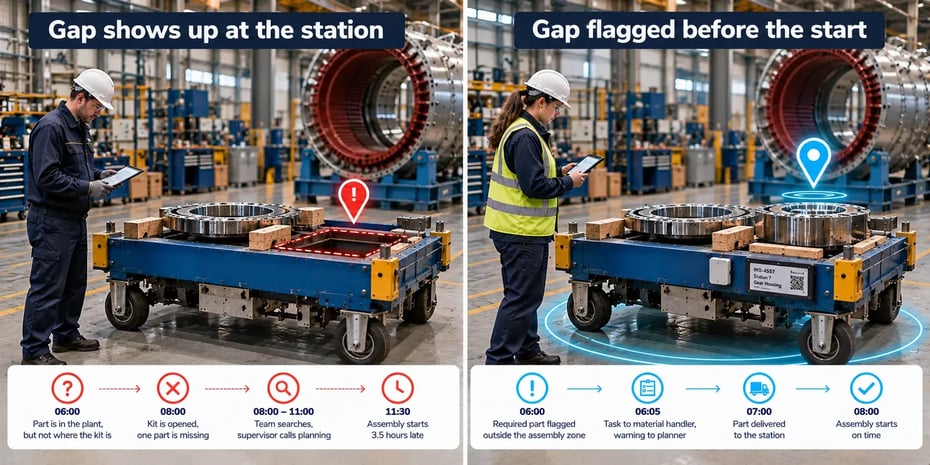
Before: the gap shows up when the team opens the kit. After: the missing part is flagged two hours before the planned start, delivered to the station, and assembly starts on time.
Why a missed slot costs more than it used to
A main assembly bay is often booked weeks in advance: the unit waits on its fixture, the team is scheduled, the crane is reserved. When one part is missing, the slot slips, and that has a ripple effect, impacting other work. The next order is pulled forward, often before its own parts are ready, and the test bay and FAT date shift with it.
Component shortages raise the stakes. Wood Mackenzie reports that power transformer lead times rose from around 50 weeks in 2021 to an average of 120 weeks in 2024, and high-voltage bushings and on-load tap changers are among the components most often flagged as build-schedule bottlenecks. When a part like that is finally on site, losing another day on the way to the line is the most expensive kind of delay. With order books this full, it can end in a missed delivery date and liquidated damages.
"A part you have been expediting for months should not miss its assembly slot on the last stretch to the line."
Thomas Miller, Chief Customer Officer, Inpixon
Start with one station
This does not have to begin as a plant-wide project. A practical first step for an RTLS platform implementation is one main assembly station, or only the orders that are critical for delivery. Define a time window, for example 24 hours before the planned start, and tag only the kits and large components for those orders.
After a few weeks, it becomes clear how often parts were in the plant but not where they needed to be, and whether it is worth extending the setup to the next station.
Three questions for your assembly area and a checklist
- How often does an assembly order start late because a part is missing, although it is already in the plant?
- How long before the planned start does anyone check that every part is at the station?
- Does your supervisor learn about a missing part from the system, or from the team at the station?